
Are you ready for some play-off baseball? I hope you are, because the play-offs start this Tuesday. The Wild Card round starts on Tuesday, and all games will be broadcast on either ABC or ESPN. The second round of the play-offs, which is called the Divisional round, will have the American League games broadcast on on TBS, truTV or Max. The National League games will then be broadcast on either Fox or FS1. The format will be the same way for the League Championship series with the NL on either Fox or FS1 and the AL games on TBS. The World Series will be available for viewing on Fox for all 7 games if necessary.

Lastly, know that MLB has decided to set these play-offs up in a way to “reward” division winners. By doing this, it makes the regular season mean more, and it keeps teams fighting to win right up until the final day of the season. In this format, the top 3 teams have an advantage, and the top overall seed has 2 advantages, or “rewards” if you will. Everything will be explained below, I promise.
How Many Teams make the Play-offs?
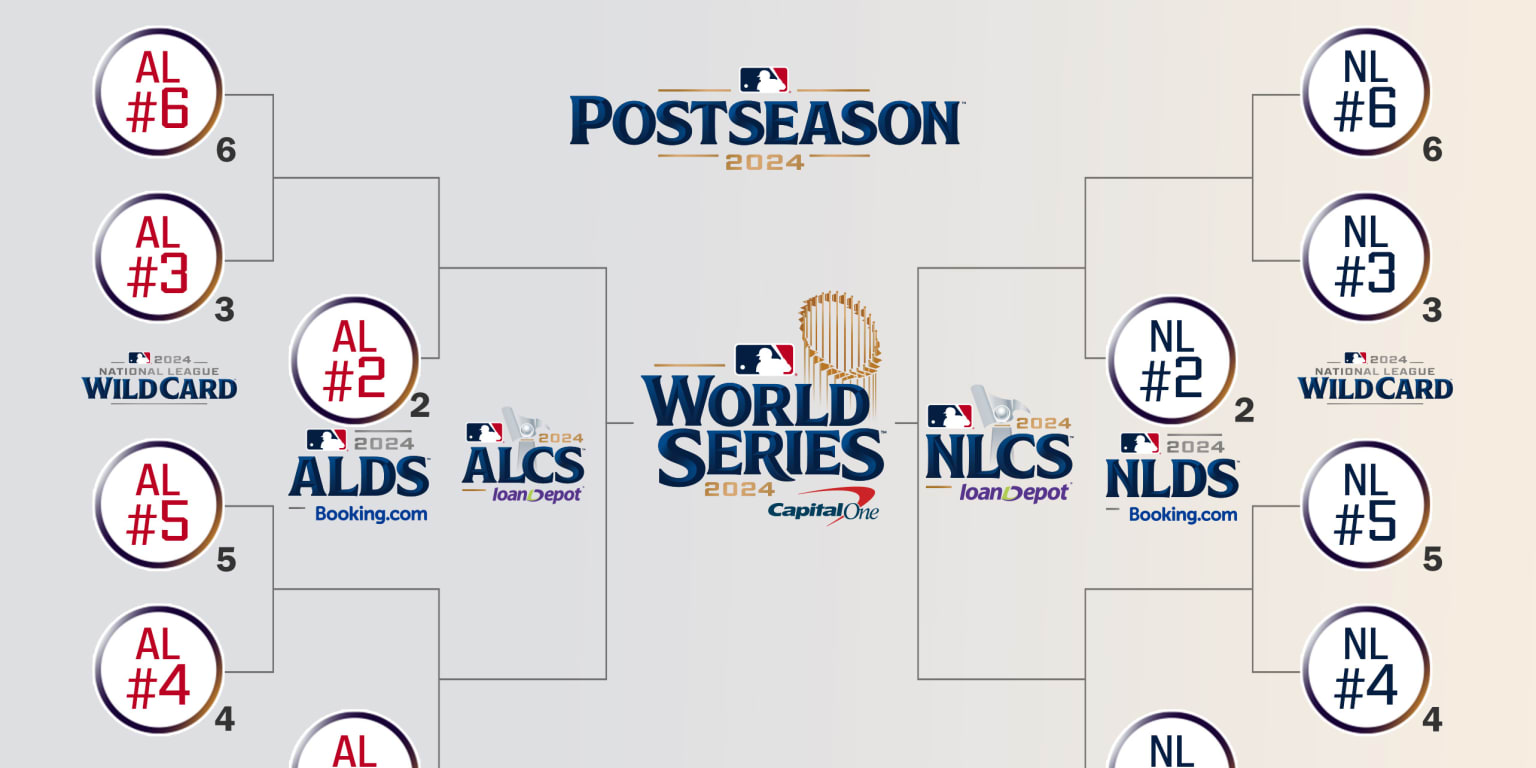
12 total teams make the MLB post season, 6 from each league. Those 6 from each league are comprised of 3 division winners and 3 Wild Card winners. There is no longer a single game elimination like there was in the past, those are now 3 game series with the 6 seed facing the 3 seed and the 4 seed and 5 seed facing each other. If you notice the top 2 seeds in each division are not involved in the first round of the play-offs. The top 2 seeds get time to rest and heal as a reward for being those top 2 division winners in the regular season.
No matter if it is the National league side or the American side of the World Series bracket, the seedings are the same. As explained above those seedings are 3 division winners and 3 wild card teams. When you break it down into those two categories, the actual seedings make much more sense. Seeds 1-3 are the division winners and are ranked against each other. What I mean by that is the ranking of the top 3 teams don’t have anything to do with the wild card teams at seeds 4-6. Baseball has decided, and rightfully so, that they should reward the three teams who win their divisions in the regular season. That is nice because it makes the regular season, all 162 games, important. Seed 1 is the division winner with the best record, Seed 2 is the division winner with the 2nd best record, and Seed 3 is the division winner with the worse record. Seed 4 is the wild card winner with the best record, Seed 5 is the wild card winner with the 2nd best record and Seed 6 is the wild card winner with the worse record.
Keeping with the “rewarding” theme for a moment, the top 2 seeds are rewarded by not playing in the wild card round. The 3rd seed is rewarded as well because yes, they have to play in the wild card round, but they do so against the 6 seed. The 6 seed has the worse overall record of the teams that did not win their division, and should be the weakest team in the play-offs.
How does the Wild Card Round Work?
All three games in the Wild Card round are played in the park of the higher seed. There are no off days, they are played on consecutive days and will be played from October 1st-3rd. That is done to keep the play-offs moving, and to give the top 2 seeds a break without getting them out of rhythm.
When you lose the Wild Card series, you are finished and you go home. No round robin or double elimination. It is win and go on the Division Series or lose and go home.
how does the Division Series Work?
First, these series increase from 3 games in a series to 5 games. The two winners from the 3 seed vs the 6 seed and the 4 seed vs the 5 seed then move on to play the 1 and 2 seeds. The teams are not reseeded after the wild card round is completed. The winner of the 3 vs 6 seed 3 game series then faces the 2nd seeded team and the winner of the 4 vs 5 seed 3 game series will face the 1st seeded team. This round of the play-offs will start on October 5th and will conclude October 12th.
The bracket is set up this way to “reward” the overall 1 seed and assure that they will face a wild card team in the division series and not another division winner.

In the wild card round of the play-offs the higher seed hosts all 3 games. In the division round, the higher seed hosts the first 2 games. Then there is an off day, and the lower seed team hosts games 3 and 4. If a 5th and deciding game is necessary, that game will go back to the city of the higher seed following a 2nd off day. This is another way of “rewarding” the division winners as they will always be the higher seeds in their match-ups with the wild card teams. Therefore, they will always have the home field advantage not just for them, but for their fans as well.
How does the Championship series work?
This series does not take a break from the division series, it is scheduled to start October 13th and will conclude October 24th if all the individual match-ups go the maximum number of 7 games each. The higher seed will host games 1 and 2 there will be a day off for travel and the lower seed will host games 3, 4 and 5 followed by another day off for travel and the series will wrap-up with the higher seed hosting games 6 and 7.

The NL series starts on the 13th and the AL series starts on the 14th. Therefore the only day from the 13th through the 24th, if both series go the maximum 7 games where there will not be baseball for you to consume will be October 19th.
How does the World Series Work?
Well, we have to start off by talking about “rewards” again. Remember the All-Star Game does not decide the home field advantage like it did for so many years (I really wish they would go back to that). In order to get the home field advantage in the play-offs you have to have the better record of the two teams. Now, this may not reward teams who win their division, but it does reward the team who won the most games in the regular season, which stills delivers the message that the regular season is important. When that home field advantage is determined the seeded format is the same for the World Series as it was in the Championship Series.
the tiebreakers
Lastly, when you do a single elimination tournament based on seed, and seed is based on regular season record, you may have some ties. Therefore, if ties are a possibility, you have to have multiple tiebreakers in place. Tiebreakers are funny in sports mostly because they have to be layered, fair, but also be effective enough that they do what they were meant to do and choose a definitive winner and looser.
The easiest way to break a tie is to just simply play another game to determine a winner. Let’s say that at the end each team has 90 wins, well play one more game and then someone is going to have 91 wins. But, the counter argument is that after doing all that work in the regular season, you are going to let one game decide your play-off fate. That renders the regular season useless, and may have players do things in that one game that may endanger themselves or their careers. So MLB came up with 5 tiebreakers to avoid such problems, here they are listed in order by the way they are used from 1 to five.
- Head-to-head records.
- Intradivision record.
- Interdivision record.
- Last half of intraleague games.
- Last half of intraleague games plus one.
I hope you enjoy the baseball play-offs. Stay tuned to WeLikeSportz for additional coverage and as always feel free to comment below and express your feelings on anything discussed in this article.
Photo Credit; MLB.com, Sporting News,


***Have you tried Dubby?? Are you looking for a Pre-Workout??
our promo code : WeLikeSportz for 10% off!


 WE LIKE SPORTZ SHOW
Leave a comment